Vitamins harder to absorb after age 50 are worth paying attention to, because aging can change the way your body obtains, absorbs, produces, and uses certain nutrients. Getting older doesn’t necessarily mean you need a cabinet full of supplements.
After age 50, changes in stomach acid, digestion, skin production of vitamin D, medications, eating habits, and certain health conditions can make it more difficult for some adults to maintain optimal levels of particular nutrients.
That is why simply asking, “Am I eating healthy foods?” may not tell the whole story.
Another important question is:
Am I actually getting—and absorbing—enough of the nutrients my body needs?
Food should remain the foundation of good nutrition. But for some adults over 50, fortified foods or supplements can help fill nutritional gaps. And when a supplement is appropriate, the form of the nutrient may sometimes matter too.
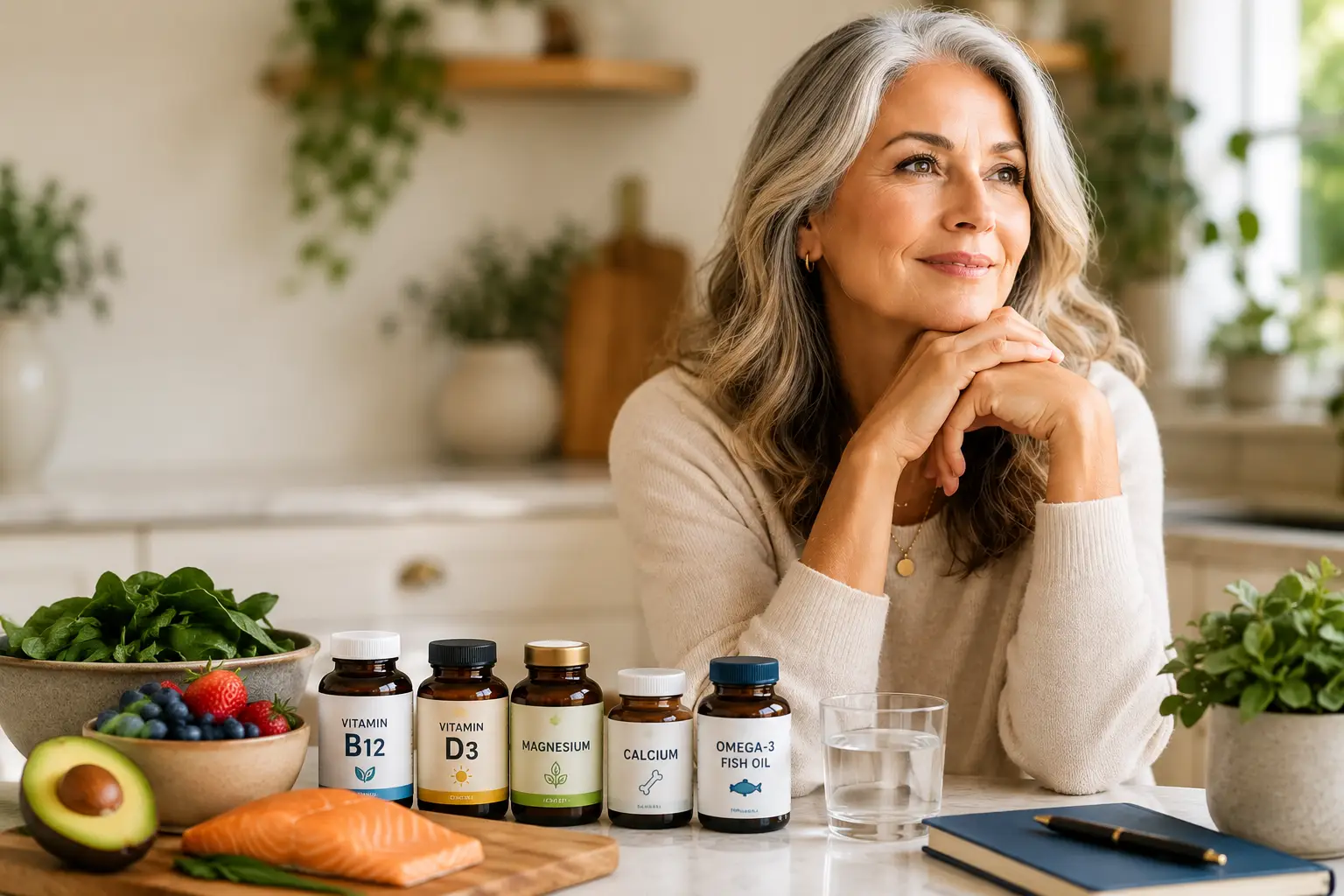
Here are five nutrients worth paying particular attention to as you get older.
1. Vitamin B12: Absorption From Food Can Become More Difficult
Vitamin B12 plays an essential role in healthy red blood cells, DNA production, and proper nervous-system function.
Excellent food sources include fish, meat, poultry, eggs, milk and other dairy products.
So why can B12 still become an issue after 50?
Your stomach normally produces hydrochloric acid that helps release vitamin B12 from the protein in food. Some older adults produce less stomach acid, which can make food-bound B12 more difficult to access.
This is important enough that the NIH Office of Dietary Supplements specifically advises people over 50 to obtain most of their recommended B12 from fortified foods or dietary supplements, because B12 in these forms does not first need to be separated from food protein.
Certain gastrointestinal conditions, stomach or intestinal surgery and pernicious anemia can further interfere with B12 absorption.
Does the form of B12 matter?
You’ll see supplements marketed as cyanocobalamin, methylcobalamin, adenosylcobalamin and hydroxycobalamin.
Marketing sometimes suggests that one form is universally superior. The evidence doesn’t justify making that claim for everyone.
The bigger issue is identifying whether you actually need additional B12 and addressing the reason for a deficiency when one exists.
Healthy Aging Takeaway: B12 is one of the clearest examples of a nutrient that deserves extra attention after 50.
2. Vitamin D: Your Skin Doesn’t Produce It as Efficiently With Age
Vitamin D is important for bone health, muscle function, nerve signaling and immune function.
Unlike most vitamins, vitamin D has another major source besides food: your skin can produce it when exposed to sunlight.
But this ability declines with age.
At the same time, relatively few foods naturally contain substantial amounts of vitamin D. Fatty fish such as salmon and trout are among the better sources, while many milks and other foods are fortified.
For adults ages 19–70, the recommended amount is 600 IU (15 mcg) daily. For adults over 70, it increases to 800 IU (20 mcg).
D2 versus D3
Supplements generally contain vitamin D2 (ergocalciferol) or vitamin D3 (cholecalciferol).
Both can increase blood vitamin D levels. However, NIH notes that vitamin D3 may raise blood levels somewhat more and for longer than vitamin D2.
That doesn’t mean everyone over 50 needs high-dose vitamin D.
Vitamin D is fat-soluble, and taking excessive amounts can be harmful. Your dietary intake, sun exposure, health history and—when appropriate—blood testing can help determine whether supplementation makes sense.
Healthy Aging Takeaway: Vitamin D becomes particularly important to monitor as we age because food sources are limited and the skin becomes less efficient at producing it.
3. Calcium: The Form Can Matter When Stomach Acid Is Low
Calcium is well known for supporting bones and teeth, but it is also involved in muscle contraction, nerve transmission and other important functions.
Dairy foods, fortified plant milks, canned fish with edible bones, tofu made with calcium and certain vegetables can contribute calcium to the diet.
But when supplementation is necessary, there is an important distinction adults over 50 should know.
The two most common forms are:
Calcium carbonate
and
Calcium citrate
Calcium carbonate is absorbed best when taken with food.
Calcium citrate is less dependent on stomach acid and can be absorbed with or without food.
That’s particularly relevant after 50 because low stomach-acid levels become more common with age. NIH notes that people with low stomach acid absorb calcium citrate more easily than calcium carbonate.
More isn’t necessarily better
Calcium also provides a great example of why supplement dosage matters.
The body absorbs supplemental calcium most efficiently in amounts of 500 mg or less at one time. Taking a very large dose all at once doesn’t necessarily mean your body will absorb all of it.
Healthy Aging Takeaway: If calcium supplementation is appropriate, calcium citrate may be particularly useful for people with low stomach acid—but your total calcium intake from food and supplements matters too.
4. Magnesium: Look Beyond the Number on the Bottle
Magnesium participates in hundreds of biochemical reactions and contributes to normal muscle and nerve function, blood pressure regulation, blood glucose control and bone health.
Good food sources include:
- Nuts and seeds
- Beans and legumes
- Whole grains
- Leafy green vegetables
- Some fortified foods
But supplement labels can get confusing because there are numerous forms of magnesium.
You’ll commonly see magnesium oxide, citrate, chloride, glycinate and others.
Are some forms better absorbed?
Yes, there are differences.
According to the NIH Office of Dietary Supplements, forms that dissolve more readily in liquid tend to be absorbed more completely. Research has found magnesium citrate, chloride, lactate and aspartate to generally be more bioavailable than magnesium oxide and magnesium sulfate.
This doesn’t automatically make one form the “best” for everyone. Cost, tolerance, dose, reason for taking it, medications and medical conditions also matter.
It’s also worth looking at the amount of elemental magnesium listed on the Supplement Facts panel rather than assuming the total weight of a magnesium compound represents the amount of magnesium you’re receiving.
Healthy Aging Takeaway: With magnesium, don’t just compare milligrams or marketing claims. The form and amount of elemental magnesium deserve attention.
5. Omega-3 Fatty Acids: What If You Don’t Eat Much Fish?
Omega-3 fatty acids aren’t vitamins, but they deserve a place in this discussion because they’re important nutrients and many people simply don’t eat fatty fish regularly.
EPA and DHA are omega-3 fatty acids found primarily in seafood, particularly fatty fish such as:
- Salmon
- Sardines
- Herring
- Mackerel
- Trout
Plant foods such as chia seeds, flaxseed and walnuts contain another omega-3 called ALA.
Omega-3s play important structural and physiological roles in the body, including within cell membranes.
If you regularly eat fish, you may already obtain meaningful amounts of EPA and DHA through food. For people who don’t, an omega-3 supplement is sometimes considered.
However, an important distinction is that taking fish-oil supplements has not been proven to prevent dementia or cognitive decline in healthy older adults. We shouldn’t turn an important nutrient into a miracle supplement.
Healthy Aging Takeaway: Think “food first.” If you rarely or never eat fish, discuss whether an EPA/DHA supplement makes sense for your individual diet and health needs.
What About Liposomal Vitamins?
This is where supplement marketing gets particularly interesting.
Liposomal supplements encapsulate a nutrient inside tiny lipid-based structures called liposomes.
The theory is that this delivery system may protect certain nutrients during digestion and potentially improve their absorption or bioavailability.
But does it actually work?
The answer is:
For some formulations, research is promising—but “liposomal” does not automatically mean better.
Vitamin C provides one of the more interesting examples.
A 2024 randomized, double-blind crossover study involving 27 adults compared 500 mg of conventional vitamin C with 500 mg of a liposomal formulation. The liposomal formulation produced higher vitamin C exposure in plasma and white blood cells.
A 2025 scoping review examined 10 studies comparing liposomal and non-liposomal vitamin C. Nine reported greater bioavailability with liposomal vitamin C. However, formulations and doses differed considerably, and researchers emphasized that more work is needed to determine whether higher blood levels translate into meaningful biological or clinical benefits.
That’s an important distinction.
Better absorption does not automatically mean better health outcomes.
And evidence for one liposomal nutrient should not be generalized to every vitamin sold in liposomal form.
What I Personally Use
As a registered nurse, I try to look at both the available research and my own individual nutritional needs when making decisions about supplements.
One supplement I personally use is liposomal vitamin C.
I chose the liposomal form because I’m interested in its delivery system and the emerging research surrounding vitamin C bioavailability.
However, that’s my personal choice—not a recommendation that everyone over 50 needs liposomal vitamin C.
A conventional vitamin C supplement may be perfectly appropriate for many people, and plenty of vitamin C can also be obtained through foods such as citrus fruits, strawberries, kiwi, bell peppers and broccoli.
Your needs may be very different from mine.
Does “More Bioavailable” Always Mean Better?
This is probably the most important lesson in this article.
When shopping for supplements, you’ll see terms such as:
Highly absorbable.
Bioavailable.
Liposomal.
Activated.
Chelated.
Premium form.
Some of those distinctions have legitimate scientific meaning.
Others are heavily used for marketing.
A supplement that produces higher blood levels isn’t automatically necessary, and taking more of a nutrient isn’t automatically healthier.
The better questions are:
Do I need this nutrient?
Am I getting enough from food?
Do I have a condition or medication that affects absorption?
Is there evidence that this particular form offers an advantage?
Is the dose appropriate for me?
Those questions matter much more than the front of the bottle.
Food First—But Supplements Have a Place
I strongly believe food should remain the foundation of healthy nutrition.
Whole foods provide combinations of protein, fiber, healthy fats, vitamins, minerals and plant compounds that a supplement can’t fully reproduce.
But “food first” shouldn’t become “supplements never.”
Vitamin B12 after 50 is a perfect example. NIH specifically recognizes that fortified foods and supplements can become important because age-related changes can interfere with obtaining B12 from naturally occurring food sources.
The goal isn’t to take as many supplements as possible.
The goal is to identify genuine nutritional gaps and address them intelligently.
Before Starting a New Supplement
Talk with your healthcare provider or pharmacist if you take prescription medications, have kidney or liver disease, have digestive or absorption disorders, are preparing for surgery, or are considering high-dose supplements.
Supplements can interact with medications, and some nutrients can accumulate or become harmful when taken in excessive amounts.
Blood testing may also be useful for certain nutrients when deficiency is suspected.
The right supplement isn’t necessarily the newest or most expensive one.
It’s the one that’s actually appropriate for you.
The Bottom Line
After 50, nutritional needs don’t suddenly change overnight—but the way your body obtains and handles certain nutrients can change.
Vitamin B12 may become harder to obtain from food because of changes in stomach acid.
Vitamin D production in the skin decreases with age and natural food sources are limited.
Calcium citrate may be easier to absorb than calcium carbonate for people with low stomach acid.
Different forms of magnesium have measurable differences in bioavailability.
And omega-3s deserve attention, particularly for people who rarely eat fatty fish.
Liposomal technology is another interesting development. Research on liposomal vitamin C suggests that some formulations can increase bioavailability, but that doesn’t mean every liposomal product is superior—or necessary.
Healthy aging isn’t about chasing every new supplement.
It’s about understanding what your body needs, choosing good food whenever possible, identifying nutritional gaps, and making informed decisions about supplementation when it makes sense.
Eat well. Supplement wisely. Age well.
About the Author
RN CJAY, RN, PMHNP
RN CJAY is a Registered Nurse with more than 30 years of healthcare experience. Through Healthy Aging Guides, she shares evidence-based information on nutrition, healthy aging, wellness and lifestyle habits to help adults over 50 make informed health decisions.
Medical Disclaimer
This article is for educational purposes only and is not a substitute for individualized medical advice. Dietary supplements may not be appropriate for everyone and can interact with medications or medical conditions. Speak with your healthcare provider before starting or significantly changing a supplement regimen.
References
- National Institutes of Health, Office of Dietary Supplements. Vitamin B12 Fact Sheet for Consumers.
- National Institutes of Health, Office of Dietary Supplements. Calcium Fact Sheet for Consumers and Health Professionals.
- National Institutes of Health, Office of Dietary Supplements. Magnesium Fact Sheet for Health Professionals.
- National Institutes of Health, Office of Dietary Supplements. Dietary Supplement Frequently Asked Questions: Vitamin D and Calcium.
- Carr AC. Do Liposomal Vitamin C Formulations Have Improved Bioavailability? A Scoping Review Identifying Future Research Directions. Basic Clin Pharmacol Toxicol. 2025;137(1):e70067.
- Purpura M, et al. Liposomal delivery enhances absorption of vitamin C into plasma and leukocytes: a double-blind, placebo-controlled, randomized trial. Eur J Nutr. 2024;63(8):3037–3046.